Datasheet4U Logo Datasheet4U.com

NB3L83948C - 2.5V / 3.3V Differential and LVTTL/LVCMOS 2:1 MUX to 1:12 LVCMOS

General Description

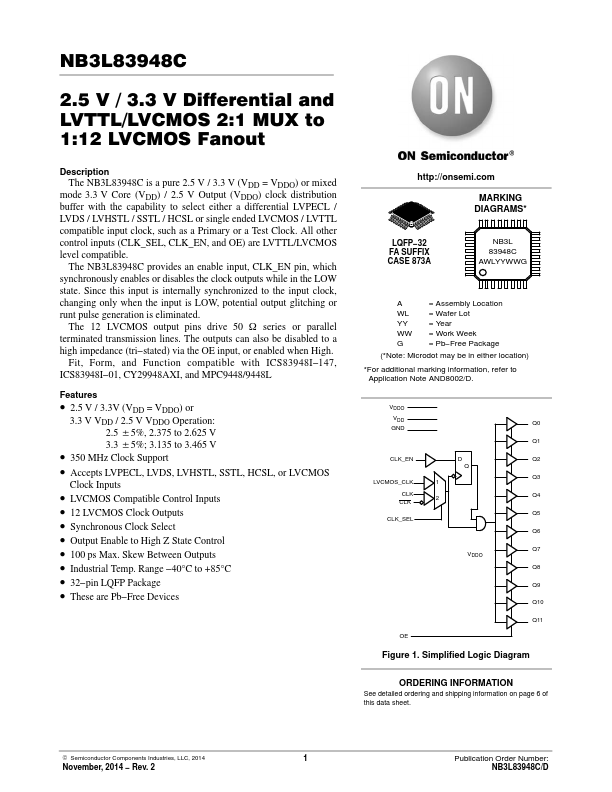
The NB3L83948C is a pure 2.5 V / 3.3 V (VDD = VDDO) or mixed mode 3.3 V Core (VDD) / 2.5 V Output (VDDO) clock distribution buffer with the capability to select either a differential LVPECL / LVDS / LVHSTL / SSTL / HCSL or single ended LVCMOS / LVTTL compatible input clock, such as a Primary or a Te

Key Features

  • 2.5 V / 3.3V (VDD = VDDO) or 3.3 V VDD / 2.5 V VDDO Operation: 2.5 $5%, 2.375 to 2.625 V 3.3 $5%; 3.135 to 3.465 V.
  • 350 MHz Clock Support.
  • Accepts LVPECL, LVDS, LVHSTL, SSTL, HCSL, or LVCMOS Clock Inputs.
  • LVCMOS Compatible Control Inputs.
  • 12 LVCMOS Clock Outputs.
  • Synchronous Clock Select.
  • Output Enable to High Z State Control.
  • 100 ps Max. Skew Between Outputs.
  • Industrial Temp. Range.
  • 40°C to +85°C.

📥 Download Datasheet

Datasheet Details

Part number NB3L83948C
Manufacturer onsemi
File Size 79.28 KB
Description 2.5V / 3.3V Differential and LVTTL/LVCMOS 2:1 MUX to 1:12 LVCMOS
Datasheet download datasheet NB3L83948C Datasheet

Full PDF Text Transcription (Reference)

The following content is an automatically extracted verbatim text from the original manufacturer datasheet and is provided for reference purposes only.

View original datasheet text
NB3L83948C 2.5 V / 3.3 V Differential and LVTTL/LVCMOS 2:1 MUX to 1:12 LVCMOS Fanout Description The NB3L83948C is a pure 2.5 V / 3.3 V (VDD = VDDO) or mixed mode 3.3 V Core (VDD) / 2.5 V Output (VDDO) clock distribution buffer with the capability to select either a differential LVPECL / LVDS / LVHSTL / SSTL / HCSL or single ended LVCMOS / LVTTL compatible input clock, such as a Primary or a Test Clock. All other control inputs (CLK_SEL, CLK_EN, and OE) are LVTTL/LVCMOS level compatible. The NB3L83948C provides an enable input, CLK_EN pin, which synchronously enables or disables the clock outputs while in the LOW state. Since this input is internally synchronized to the input clock, changing only when the input is LOW, potential output glitching or runt pulse generation is eliminated.